

Professor Jodie Roure, a loyal Super Bowl patron, jolted out of her seat. The crowd around her also surged as Bad Bunny strutted down the field, starting the opening number of his polarizing Super Bowl halftime show performance.
She cried and yelled “Wepa!” as Spanish was sung aloud in Levi’s Stadium. Roure felt a rush from hearing her language spoken in an American sports arena, but, more importantly, the moment embodied everything she has spent her life fighting for.
“Hearing Spanish centered unapologetically on that stage was profoundly emotional for me,” she said.
Roure is a Puerto Rican scholar in John Jay College’s Department of Latin American and Latinx Studies. She has spent decades performing philanthropic work and extensive research, while also advocating for human rights across the United States and Latino countries.
The expertise she has developed clearly shapes the courses she teaches. In her most popular course, Bad Bunny Latinx Activism & Social Change, she guides students through the intersections of politics, culture, and identity across Latin America and the U.S. Latinx diaspora.
Roure’s excitement at the Super Bowl game was a clear moment of resistance in America’s current political climate. A place where a halftime show performance can become a site of division.
In the weeks leading up to the game, Bad Bunny’s awaited performance was pulled into national debate with conservative commentators urging viewers to skip the broadcast entirely. Instead, they asked ideologically aligned viewers to tune into an “alternative” halftime show produced by Turning Point USA.
The morning after the game, Florida Representative Randy Fine urged the Federal Communications Commission (FCC), the regulator of U.S. communications, to take legal action against the artist and the NFL. Representative Fine blatantly called the performance “illegal.” Yet, the FCC rejected the request, finding no violations of “pornographic filth” or explicit words, as described by Fine.
Beyond causing political noise, Bad Bunny’s performance raises a deeper question about who gets to be seen and celebrated in American media.
Ashley Velez, video production and media theory professor at John Jay College, said the scale of the Super Bowl halftime show is what makes it uniquely powerful.
“You’re performing for tens of millions of viewers across the political spectrum,” she said.
Velez’s point emphasizes that the halftime show isn’t just another performance—it’s one of the few remaining moments in media where the entire country is watching as one, which makes any cultural message feel larger and more consequential.
Velez also noted that today’s media environment is increasingly fragmented and polarized.
“That shift [in the media] pushes audiences into more partisan spaces and deepens distrust in mainstream media, turning events like the halftime show into cultural battlegrounds,” she said.
Another John Jay College voice, Jasier Tejeda, an Afro-Dominican senior enrolled in Roure’s course, explains how Bad Bunny’s music echoes the themes explored in her coursework.
Tejeda and her classmates discuss how the United States functions as a colonial empire, pointing to places like Hawaii, Guam, and Puerto Rico as examples of territories shaped by unequal power and overwhelming military presence. When the United States annexed these islands in the late 19th century, residents were granted U.S. citizenship without full political rights, but the islands remained under federal control.
This framework helps students understand why themes of resistance to colonialism and protection of the island and its population appear so frequently in Bad Bunny’s music.
“Bad Bunny has been singing about colonialism and its problems for a long time now. This is nothing new,” Tejeda said. “In the course, we get to analyze the consequences of American imperialism, and evaluate the colonized. We get a sense of this when we watch Bad Bunny address these topics in his unique, artistic way in his music and on stage.”
While John Jay College students study these ideas in an academic setting, they also resonate deeply in New York neighborhoods shaped by Puerto Rican migration.
During the halftime show, Bad Bunny performed “NuevaYol,” a tribute to the mid‑20th century wave of Puerto Ricans who settled in the city and helped forge the Nuyorican identity. Bad Bunny’s decision to feature Maria Antonia Cay, owner of the Caribbean Social Club in Williamsburg, honored the community spaces that have long anchored Puerto Rican culture in New York City.
Cay opened the Caribbean Social Club in the 1970s, when Williamsburg was still called Los Sures. The community was a working‑class Puerto Rican enclave long before high rise apartments and private parks remade the neighborhood. Yet, while gentrification pushed out much of the Puerto Rican community, her club stands as one of the last remaining spaces where Puerto Ricans feel at home.
In addition to Williamsburg, that connection remains undeniable in Spanish Harlem.
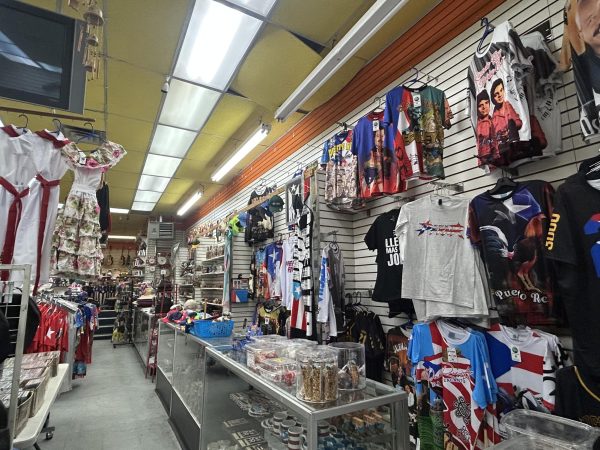
Outside El Barrio Music Center on Lexington Avenue, a small Puerto Rican‑themed entertainment shop, music from Puerto Rican artists play through a large speaker that fills the block with the kind of warmth that is welcoming even in the city’s harsh winter.
While out on her delivery route, Gigi Perez, a Spanish Harlem resident and Nuyorican merchandiser for the music store, said the Super Bowl performance carried a sensation of unification and love she immediately recognized.
Yet, Perez could not avoid the painful truth in the imagery.
Bad Bunny incorporated a striking visualization of the aftermath of 2017 hurricanes Irma and Maria, featuring dancers as utility workers climbing sparking power poles. This portion of the performance symbolized the long-term power grid failures in Puerto Rico following the storms.
“The part he showed about Puerto Rico is that we’ve been abandoned for a while,” she said.
While the blackouts in Puerto Rico are a reminder that federal governments can overlook their own citizens, Perez believes this neglect mirrors the way the current presidential administration talks about Latinx communities, often lumping Puerto Ricans into immigration debates that don’t apply to them.
“We’re not immigrants. We’re Americans,” she said.
The imagery of the halftime performance stayed with Perez long after the broadcast ended. Yet, she was reminded of Puerto Rico’s long-standing endurance. Along with the bold dance numbers and costumes, she could see the families who rebuild after storms, communities that carry memories across oceans, and a diaspora that continues to assert its place in American life.
In a country increasingly divided over who gets to be viewed as “American,” the halftime performance offered something rare: an experience where Latinx pride could be celebrated openly.
Roure felt the weight of that visibility in her bones.
“In that moment, I felt very jíbara. I felt proud of my people, of our endurance, of our artistry, and of what we contribute to the world.”